

- This event has passed.
SCEHSC/ShARP Seminar: Dr. Lidia Mínguez-Alarcón
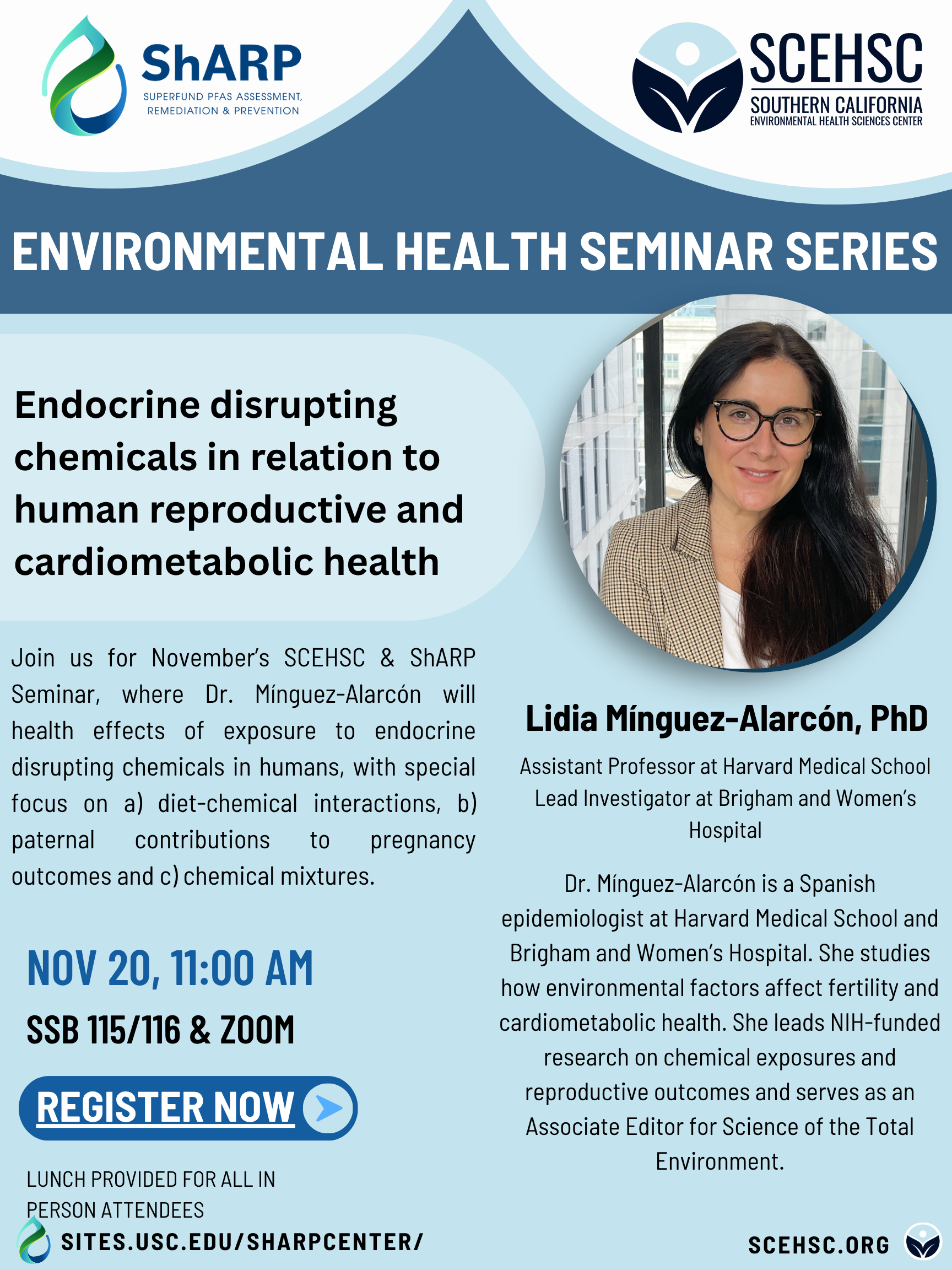
Join us for November’s SCEHSC Seminar, where Dr. Lidia Mínguez-Alarcón will discuss health effects of exposure to endocrine disrupting chemicals in humans, with special focus on a) diet-chemical interactions, b) paternal contributions to pregnancy outcomes and c) chemical mixtures.
Dr. Mínguez-Alarcón is a Spanish epidemiologist with joint appointments both at the Harvard Medical School and Brigham and Women’s Hospital (Assistant Professor of Medicine/Lead Investigator). Her research focuses on identifying chemical and non-chemical stressors of human fertility, reproductive and cardiometabolic health. Results from her work have been used by national and international agencies (e.g. European Food Safety Authority). Dr. Mínguez-Alarcón is the PI of the NIH funded Longitudinal Investigation of Health and Diseases after Infertility (LIHDI) Study, which is prospectively exploring chemical exposures during reproductive years in relation to long-term cardiovascular and metabolic health. She is also the PI of another NIH R01 that evaluates paternal pesticide exposure in relation to couple’s pregnancy outcomes and associations with sperm and leukocyte epigenome. She brings her expertise to the Science of the Total Environment (STOTEN) journal as an Associate Editor and the Reproductive, Perinatal and Pediatric Health (RPPH) NIH study section as a Grant Reviewer. Most of her teaching includes mentoring of individual students from Harvard TH Chan as well as residents and fellows at Harvard-affiliated hospitals.
Please register below to attend the seminar in-person or on Zoom. Please note that due date for lunch orders is noon on MONDAY, NOVEMBER 17TH. After this, we will no longer accept lunch orders, but we will still take sign-ups for attendees both on Zoom and in person. Thank you!
This program is open to all eligible individuals. Keck School of Medicine of USC operates all of its programs and activities consistent with the University’s Notice of Non-Discrimination. Eligibility is not determined based on race, sex, ethnicity, sexual orientation, or any other prohibited factor.